
In a world where global warming is rapidly rising and heatwave fatalities are increasing, the root cause is clear: an excess of heat-trapping gases like carbon and nitrogen in our atmosphere. If we can successfully remove these gases, we can cool our planet.
Modern industries and human practices have consistently worked against nature. Yet, for the very crises we have created, nature remains the ultimate solution. These atmospheric gases can be absorbed and processed by the help of trees—more and more trees. If we can cover our urban concrete spaces with miniature forests, this dire picture can completely change.
Notice I said a forest, and not a garden. What exactly is the difference between the two?
The Core Difference: Control vs. Connection
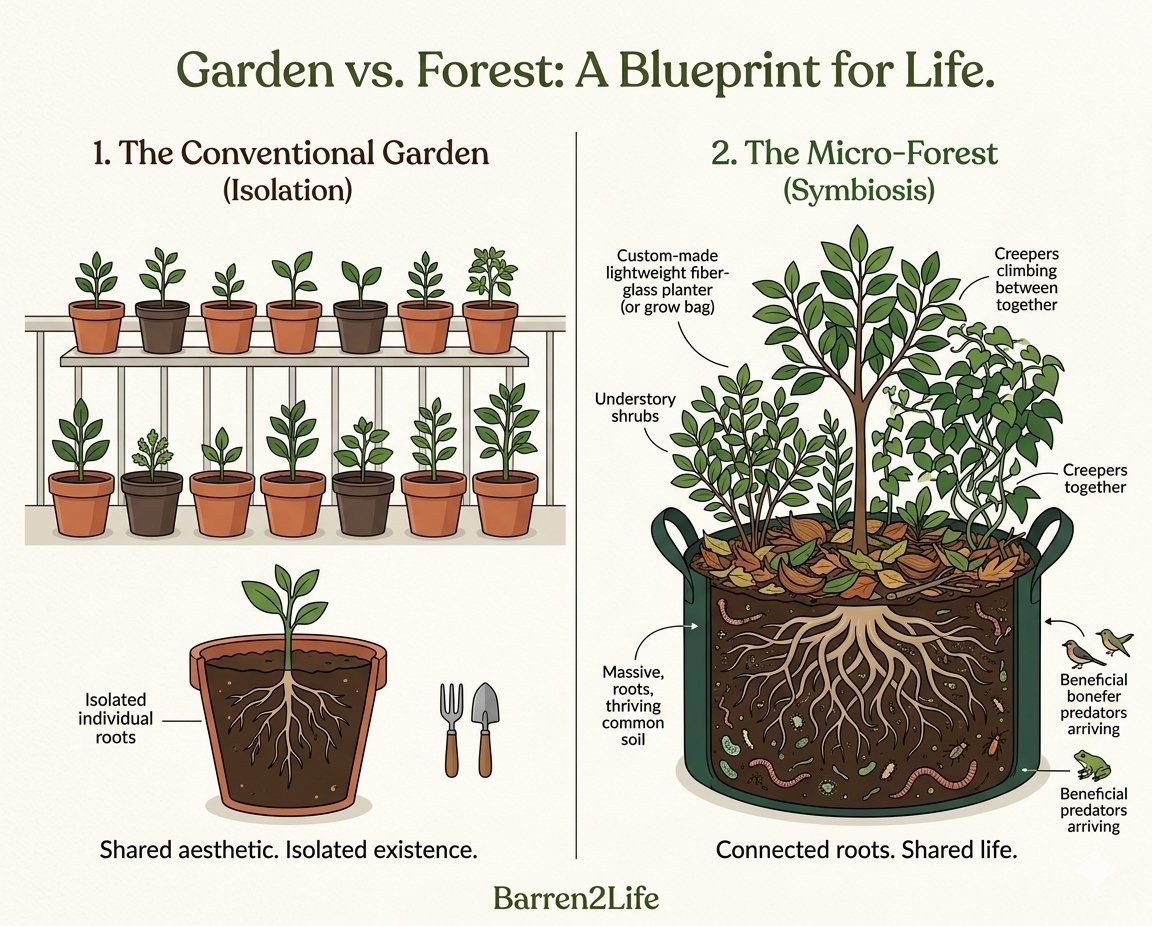
In very simple terms, the standard practice everyone follows is “one plant, one pot.” A collection of these individual pots makes a garden. Traditional gardens are fundamentally designed for humans. The priority is landscaping—allocating space for sitting, walking, and placing aesthetics on top. While a garden is certainly better than doing nothing, it is still a system of human control.
Now, consider the forest.
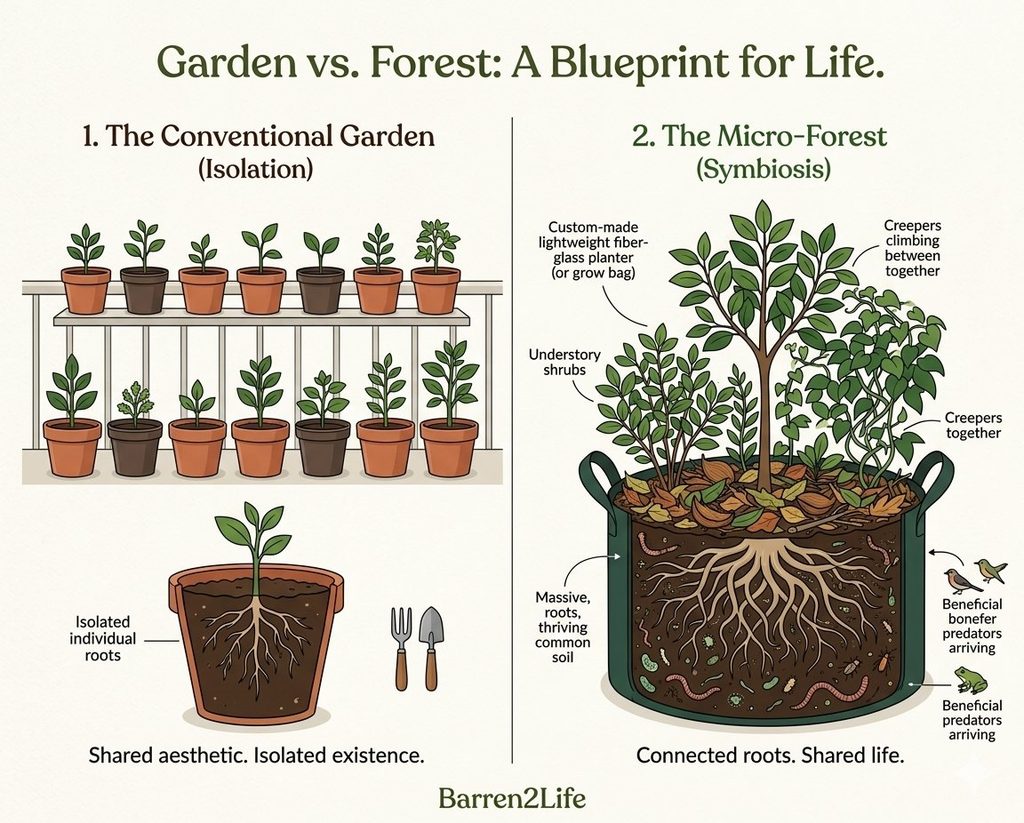
In a forest, everything is deeply connected. All plants grow together, sharing one common, living soil. Here, the priority is not human aesthetics, but the symbiotic relationships taking center stage. A forest is a whole ecosystem split into two vibrant layers: the world above, and the world below.
The World Above: Layers of Light
Above the soil, plants arrange themselves in layers based on evolutionary intelligence:
- The Canopy: The tallest trees form the top layer, catching the maximum intensity of the sunlight.
- The Understory: Shrubs and smaller trees thrive just below, evolving to utilize the filtered light.
- The Climbers: Creepers climb high, using the sturdy support of the trees to reach up and catch their share of sun.
Crucially, forest soil is never bare. It is always protected. It is shielded by low-lying ground cover plants and a natural blanket of mulch created by dry, fallen leaves.
The World Below: The Secret Life of Soil
Beneath the surface lies a magnificent life cycle driven by beneficial insects, microbes, and fungi.
Plants capture carbon from the atmosphere through photosynthesis, but they cannot directly absorb nitrogen—even though nitrogen makes up 78% of our air. Who bridges this gap? The microbes in the soil.
There is a beautiful, sacred transaction here: plants provide sugars (energy) to the microbes, and in return, the microbes convert atmospheric nitrogen into bioavailable nitrates that the plants can feed on. The waste matter from these microbes and soil insects delivers vital nutrients directly to the root systems. Meanwhile, networks of fungi feast on dead organic matter, breaking it down into life-giving nourishment.
To keep this entire system balanced, nature relies on a perfect predatory cycle. There is no overpopulation.
For example, I often hear urban gardeners struggling with slugs, using complicated remedies like copper tapes. But in a real forest, no human manages the pests. Everything operates by the absolute laws of nature. If any organism becomes excessive, the ecosystem takes care of it because every creature has a purpose. A slug’s role is to decompose raw organic matter into nutrients. It only damages a plant if it lacks its primary food source (leaf mulch), and even then, native plants have developed their own evolutionary mechanisms to handle it. When the slug population increases, predatory insects, birds, and frogs naturally arrive to restore the balance.
There is no one taking care of a forest. They are entirely self-sustaining. The plants communicate, support one another, and thrive as a single organism.
How to Transform Your Urban Space into a Forest
So, the main question arises: How do we create a forest within our rigid urban spaces? If you already have a conventional balcony or terrace garden, how do you convert it into a thriving micro-forest?
Here are the foundational guidelines to transition your space:
1. Unify the Root System: Since everything in a forest is connected, replace your isolated single pots. Move your plants into large, lightweight fiberglass planters or spacious grow bags where the soil can be shared by as many different plant species as possible.
2. Eliminate Chemical Fertilizers: Stop using synthetic chemicals completely. They disrupt the natural chemistry of the soil.
3. Step Away from Commercial Organic Inputs: You do not even need expensive store-bought organic fertilizers. Our goal is to let nature take over the work entirely.
4. Feed the Soil Biology: Microbes need natural catalysts. Utilize the principles of Natural Farming by feeding your soil Jeevamrutam or Ghana Jeevamrutam to activate microbial life. For pest management, simple homemade remedies like diluted sour buttermilk work wonders. Feed the soil system directly using raw organic matter available right in your kitchen, like fruit and vegetable peels.
5. Design in Vertical Layers: Arrange your plants systematically based on their specific sunlight requirements—canopy plants on top, shaded shrubs below, and creepers climbing between them.
6. Never Leave the Soil Exposed: Cover every inch of open soil with a thick layer of mulch. Use whatever natural materials are easily accessible to you: dry fallen leaves, coconut husk (coir), rice husk, or dried sugarcane bagasse.
7.Moist & Aerated Soil: Instead of flooding your plants or practicing heavy irrigation, focus on achieving a state where the soil retains a perfect balance of water vapor and air pockets, ensuring moisture without choking the roots.
8. Observe and Yield to Nature: The most critical rule is to simply observe. If something is unbalanced, nature will guide you. You just need to be quiet, aware, and willing to learn.
— Written by
Rutuja Kulkarni
Founder Barren2Life


Leave a Reply