
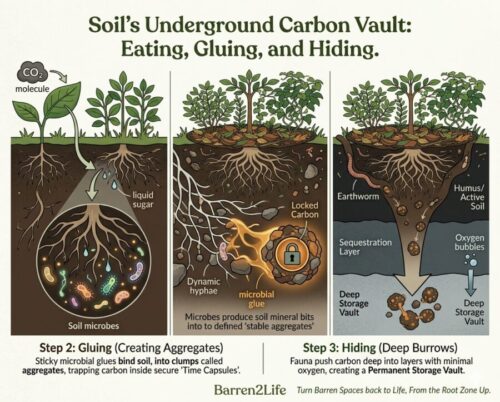
Climate change has become our topmost urgency. Often, when we see global efforts to fight it, the focus is entirely on tree plantation drives. Large, majestic trees are considered the most impactful. Because of this, we usually think that to make a difference, we must own vast lands to plant trees or join distant volunteering groups.But that is not true. You just need to look toward one critical, unsung hero. The secret lies right beneath our feet: Healthy Soil.
In fact, the Earth’s soil holds about three times more carbon than the entire atmosphere, and more than all living plants and trees combined. But how exactly does soil capture carbon?
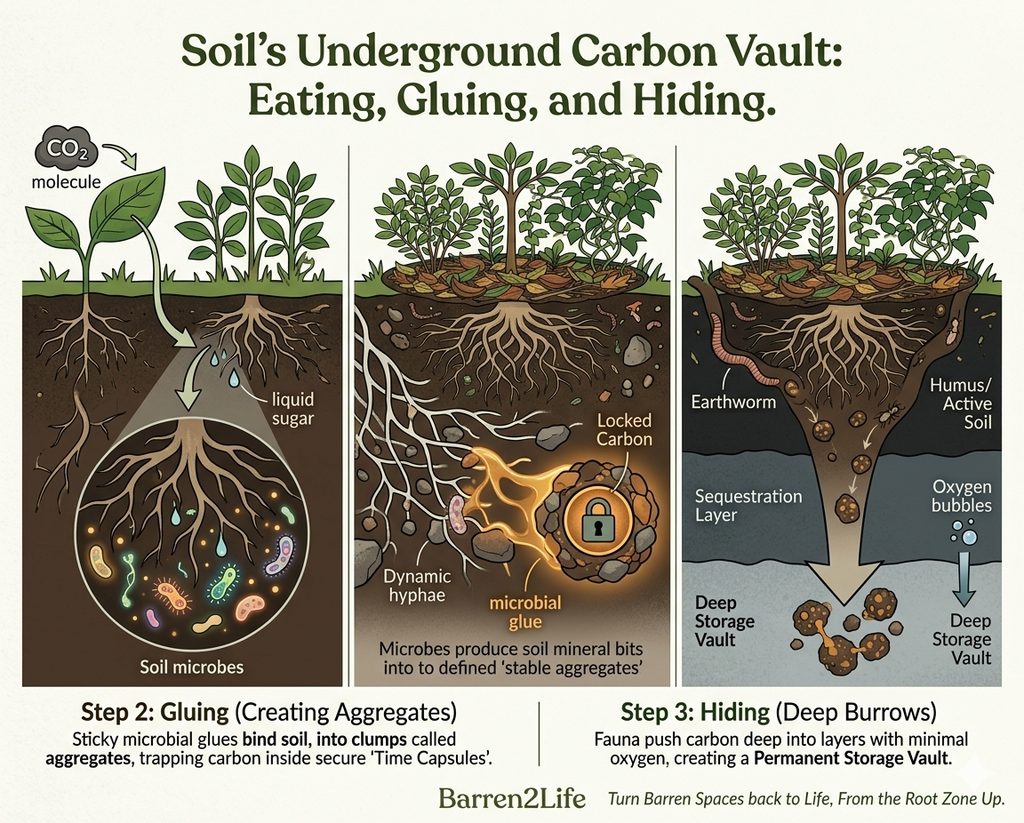
Let me explain it in very simple terms. Think of the soil as a giant underground storage vault. Carbon gets locked inside it through three simple steps: eating, gluing, and hiding.
The Three Steps to Underground Carbon Storage
Plants naturally capture carbon dioxide from the atmosphere through photosynthesis. This carbon goes into building their leaves, bark, and stems, but a significant portion travels down to the roots as liquid sugars to feed the underground world.
Here is exactly how that carbon from the plant sugars gets trapped inside the dirt:
Eating and Dying: Microbes (like bacteria and fungi) drink those plant sugars and eat decaying root matter, building their own microscopic bodies out of that carbon. When billions of these tiny microbes eventually die, their carbon-rich remains stick directly to the dirt particles.
The “Glue” Effect: As microbes process their food, they produce sticky, gooey substances. This acts like a natural cement, binding tiny bits of sand, silt, and clay together into small clumps called aggregates. The carbon gets trapped right in the center of these hard clumps, like a time capsule. Because it is sealed inside, other organisms cannot reach it, keeping the carbon safely locked away.
Deep Hiding: Earthworms, burrowing insects, and deep-growing roots physically push and pull this organic material deep into the earth. Down deep in the soil matrix, there is very little oxygen. Without oxygen, underground bacteria slow down drastically and cannot break down the matter, keeping the carbon buried for hundreds or even thousands of years.
How Does Healthy Soil Look and Feel Like ?
I am sure you have walked into a forest before. Do you remember the scent in the air after it rains? That beautiful, rich earth fragrance is the smell of life.
Healthy soil smells exactly like that forest floor. Visually, it is dark, deep black, and naturally moist. This appearance means that humus—the ultimate organic foundation of soil—has successfully built up. In this rich, spongy environment, plant roots can easily penetrate deep into the earth, drawing vital nutrients effortlessly from an abundant underground vault.
The Problem: We Are Creating Dead Soil
All of this magical engineering happens only when the soil is healthy.
Unfortunately, what we see in most urban environments today is dead soil. Exposed, dry dirt cannot hold carbon; it actually releases carbon back into the atmosphere as it degrades.
Chemical fertilizers give a sudden, artificial boost to plants—like a shot of glucose. They might force the plant to give you quick flowers and fruits, but they simultaneously kill the microbial population in the soil. If the microbes are destroyed, this natural carbon-capture cycle completely breaks down.
How to Turn Your Soil into a Carbon Trap
To turn your Soil into an active carbon sink, you just need to follow a few simple, natural laws:
Stop Digging (No-Till): Every time you dig, turn, or disturb the soil, you tear up the delicate fungal networks (mycorrhizae) and expose the trapped carbon to oxygen, causing it to escape. Let the earthworms and microbes handle the aeration for you naturally.
Keep It Covered (Mulch Constantly): Never let the harsh sun hit bare soil. Cover it with a thick, protective blanket of organic matter. Use what is easily available at home: dry fallen leaves, coconut husk, rice husk, or dried sugarcane fibers. Mulch keeps the soil cool, retains moisture, and provides food for surface insects to process into deeper layers.
Cultivate High Plant Diversity: Plant multiple species together in the same shared bed. Different plants secrete different types of carbon sugars, which attracts a wider variety of microbes, building a much stronger and more resilient carbon-trapping ecosystem.
Feed with Microbial Inoculants: Use natural catalysts like Jeevamrutam or homemade sour buttermilk to kickstart and multiply the microbial population. Feed the ecosystem with raw kitchen scraps like vegetable and fruit peels.
— Written by
Rutuja Kulkarni
Founder Barren2Life
Leave a Reply